Hardware · Jan 2023 to May 2024
Cryo-Compression Device for CIPN Treatment
Kyro Vac: a Peltier and vacuum-bladder cryo-compression prototype for chemotherapy-induced peripheral neuropathy, built to clinical temperature and pressure targets for the hand at a 91.7% cost reduction versus the commercial alternative.
Problem statement
Chemotherapy-induced peripheral neuropathy (CIPN) is nerve damage caused by chemotherapy drugs. It affects roughly 68% of chemotherapy patients overall and up to 90% of patients on neurotoxic regimens like platinum agents, taxanes, and vinca alkaloids. The symptoms (numbness, tingling, burning pain, and loss of fine motor control in the hands and feet) can be severe enough to force dose reduction or discontinuation of treatment, and they often persist long after chemotherapy ends.
Cryo-compression, meaning cooling plus cyclical external pressure applied during infusion, is one of the most promising preventive approaches in the literature. The problem is that the clinical evidence sits on devices that either target the scalp or use bulky water-cooled architectures, with higher-end commercial cryo-compression systems (Paxman-class and similar) running on the order of ~$6,400. None of the commercially available options conform to the topography of the hand, which is where CIPN most often presents first and limits quality of life the most. Frozen gloves, the closest low-cost option, have roughly a one-third discontinuation rate because they are uncomfortable and cool non-uniformly.
The client on this project was Dr. Marilyn Huang, an oncologist in the Division of Gynecologic Oncology at UVA Health. The brief was a portable cryo-compression device targeting the hand specifically that could run through the full infusion-flanking protocol (30 minutes before, up to 6 hours during, and 30 minutes after chemotherapy) on a tight hardware budget.
My role and contributions
I worked across the full design cycle: client interview synthesis, literature review, requirements definition, ideation of alternative designs, fabrication of the final prototype, and the bench and human-factors testing protocol. My focus was the thermal path (Peltier stack, hot-side heat rejection, duty cycling) and the compression mechanism (vacuum-driven elastic bladder instead of an inflatable cuff), plus the test plan that let us measure all three design constraints independently.
Technical approach
The architectural decision that drove everything else was choosing Peltier thermoelectric cooling plus vacuum compression over the industry-standard water-cooled-cuff pattern. Water cooling is heavy, requires a reservoir and tubing (fouling, clogging, cleaning), and is why clinical-grade cryo-compression systems cost in the ~$6,400 range and stay tethered to a cart. Swapping to solid-state Peltiers with active heat-sink rejection and battery power collapses the whole system into something roughly the size of a ski glove.
On the compression side, we rejected the inflatable-cuff pattern (sphygmomanometer-style) because it applies pressure in rings around the hand and cannot reach between the fingers, which is exactly where CIPN presents worst. The final design uses a sealed elastic bladder that the user slips their hand into, plus an inline vacuum pump that evacuates air from the bladder. The resulting negative pressure forces the bladder to conform isotropically to the entire topography of the hand, including between the fingers, which is a behavior the inflatable-cuff option cannot deliver at any price.
Design targets were pulled from the client interview and the CIPN literature:
- Skin-side temperature in the clinical sweet spot, 10 to 20 degrees Celsius (cold enough for vasoconstriction, above freezing to avoid frostbite).
- Steady-state pressure of 30 to 35 mmHg, cyclical rather than static.
- Full protocol runtime covering the pre-infusion, intra-infusion, and post-infusion window on battery.
- Hand and fingers coverage, portable enough for a chair-side setup, with a total build cost a small fraction of the ~$6,400 commercial baseline.
Final prototype, named Kyro Vac internally:
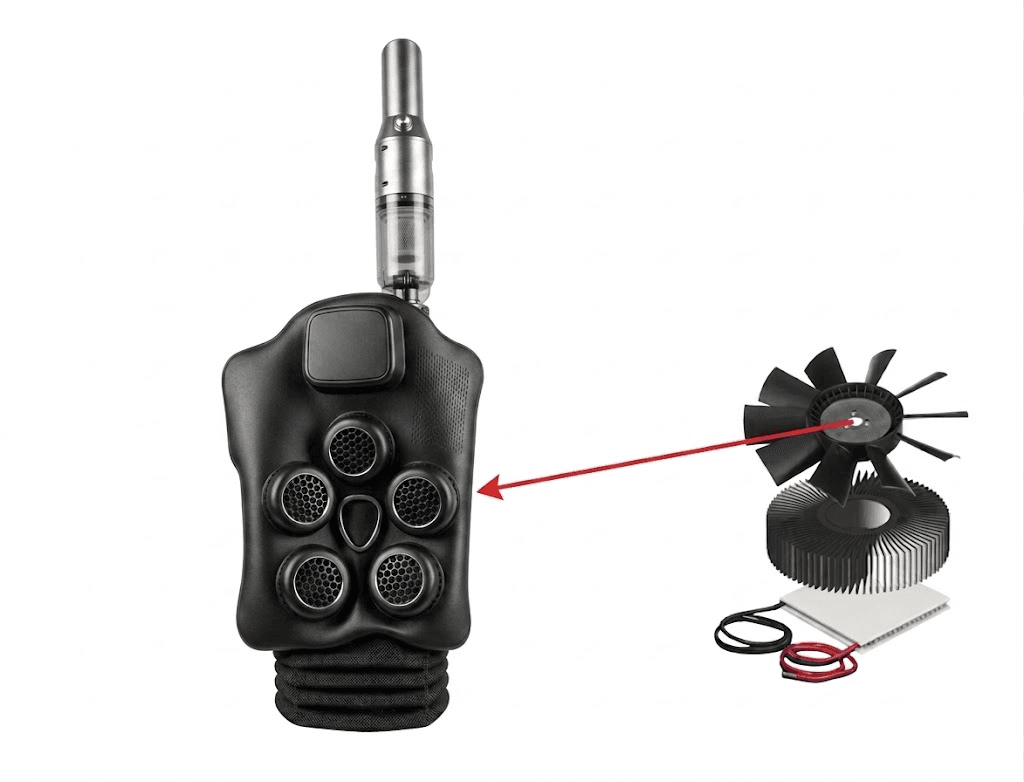
Shell:        hand-sized enclosure with 5 Peltier modules on inner surface
Thermal:      HyperIce-X cooling unit, battery + app-controlled setpoint
              Peltier cold face -> hand; hot face -> heat sink + fan
Compression:  sealed elastic bladder (heat-sealed polymer sheet)
              external vacuum evacuates air -> negative pressure
              conforms isotropically, including between fingers
Control:      app-based temperature setpoint; cyclical pressure via vacuum cycling
Total mass:   ~3 lb, fully battery powered
Build cost:   ~$530 in parts
Testing
Three things had to be proven independently: cooling rate, pressure distribution, and comfort. The test plan attacked each on its own axis to avoid cross-contamination:
- Thermal response: a temperature probe was fitted tight inside the sealed bladder so the signal was not contaminated by ambient air. The device was run from room temperature to setpoint, repeated 5 times, and averaged at 10-second intervals to build a time-to-target temperature curve.
- Pressure distribution: 10 randomly selected participants from outside the design team used the device with cooling disabled, so the only variable was how evenly the vacuum-formed bladder pressurized their hand. They scored uniformity on a structured survey.
- Comfort and perceived cooling: the same 10 participants used the device with cooling on and scored perceived coldness and overall comfort.
Results
- Time to clinical temperature: the device reached the 10 to 20 degrees Celsius band in roughly 1 minute, comfortably inside the pre-infusion setup window.
- Pressure distribution: the weakest axis. Participants consistently reported that the vacuum-bladder solution pressurized the hand better than a cuff-style device would have, but uniformity still had room to improve, and that finding pointed directly at the bladder material as the highest-leverage next iteration.
- Comfort and cooling: majority of users rated comfort and perceived cooling as sufficient, with the same bladder-material feedback driving the comfort score.
- Cost: approximately $530 in parts versus ~$6,400 for the surveyed commercial cryo-compression reference device on the same functional spec, a 91.7% cost reduction.
- Form factor: ~3 lb, battery powered, no water reservoir or tubing. Maintenance reduces to bladder replacement instead of cleaning and de-clogging a fluid loop.
The device met every design constraint the client laid out: portable, battery-powered, hand and fingers specific, within clinical temperature and pressure bands, and roughly an order of magnitude closer to being affordable than the water-cooled alternatives.
Stack notes
Peltier thermoelectric modules, HyperIce-X cooling unit, heat sink and fan for hot-side rejection, vacuum pump for compression, heat-sealed elastic bladder, companion app for temperature control, mechanical CAD for the outer shell, structured human-factors surveys, and time-series thermal instrumentation. Built for a clinical client in the Division of Gynecologic Oncology at UVA Health.
Tech stack
- hardware
- medical device
- Peltier cooling
- vacuum compression